Tuesday, 20 October 2015

SBVLC: Secure Barcode-Based Visible Light Communication For Smartphone’s


ABSTRACT
As an alternative to NFC technology, 2D barcodes have been increasingly used for security-sensitive applications including payments and personal identification. However, the security of barcode-based communication in mobile applications has not been systematically studied. Due to the visual nature, 2D barcodes are subject to eavesdropping when they are displayed on the screen of a smart phone. On the other hand, the fundamental design principles of 2D barcodes make it difficult to add security features. In this paper, we propose SBVLC - a secure system for barcode-based visible light communication (VLC) between smartphones. We formally analyze the security of SBVLC based on geometric models and propose physical security enhancement mechanisms for barcode communication by manipulating screen view angles and leveraging user-induced motions. We then develop two secure data exchange schemes. These schemes are useful in many security-sensitive mobile applications including private information sharing, secure device pairing, and mobile payment. SBVLC is evaluated through extensive experiments on both Android and iOS smartphones.
AIM
The aim of this paper is formally analyze the security of SBVLC based on geometric models and propose physical security enhancement mechanisms for barcode communication by manipulating screen view angles and leveraging user-induced motions.
SCOPE
The scope of this paper is SBVLC is evaluated through extensive experiments on both Android and iOS smart phones.
EXISTING SYSTEM
The proliferation of smart phones puts a portable camera in everyone’s pocket, making eavesdropping much easier. This is exacerbated by widely spread use of surveillance cameras in public areas like shopping malls. On the other hand, the fundamental design principles of 2D barcodes make it difficult to add security features. First, a 2D barcode only contains a small amount of information and hence cannot simply adopt advanced encryption primitives. Moreover, most existing barcode applications are based on a single barcode exchange, which is insufficient for establishing a secure communication channel. Recently, several systems are designed to stream a series of barcodes between a LCD screen and smart phone camera. These systems can enable high-throughput ad hoc communication between smart phones; however, they are designed based on highly customized barcodes which are not widely adopted in practice
DISADVANTAGES
·      Due to the visual nature, 2D barcodes are subject to eavesdropping when they are displayed on the screen of a smart phone
·      The fundamental design principles of 2D barcodes make it difficult to add security features
PROPOSED SYSTEM
In this project, we investigate secure barcode based communication for smart phones. Due to the inherent directionality, the visible light communication (VLC) channel of barcode exchanges yields interesting security properties. We formally analyze the security of VLC based on geometric models and propose security enhancement mechanisms such as manipulating view angles and leveraging user-induced motions. We then develop three secure data exchange protocols that encode information in barcode streams. We believe that the proposed protocols are useful in many mobile applications including private information sharing, device pairing, and mobile payment systems, etc. further propose two secure communication schemes. The first scheme, two-phase message transfer scheme, is an ultra-lightweight solution to secure smart phone data exchange and mobile payment. The second scheme, all-or-nothing data streaming scheme, is tailored for secure temporary data transfer without key exchange. It adopts the secret sharing scheme to enhance the channel security it preserves the confidentiality of all the transmitted data, if the eavesdropper misses at least one barcode frame during the entire communication. Both proposed schemes are evaluated through extensive experiments on both Android and iOS smartphone platforms
ADVANTAGES
·      Our system achieves high level security and NFC-comparable throughput
·      The system can be used for private information sharing, secure device pairing and secure mobile payment, etc.
 SYSTEM ARCHITECTURE


SYSTEM CONFIGURATION

HARDWARE REQUIREMENTS:-

·                 Processor  -   Pentium –III

·                Speed                -    1.1 Ghz
·                RAM                 -    256 MB(min)
·                Hard Disk         -   20 GB
·                Floppy Drive    -    1.44 MB
·                Key Board        -    Standard Windows Keyboard
·                Mouse               -    Two or Three Button Mouse
·                Monitor             -    SVGA

SOFTWARE REQUIREMENTS:-

·                Operating System              : Android OS                                       
·                Front End                  : JAVA
·                Database                  : Sqlite
·                Tool                           :Eclipse


REFERENCES
Kui Ren, Guoliang Xing, Xinwen Fu, Bingsheng Zhang, “SBVLC: Secure Barcode-based Visible Light Communication for Smart phones”, IEEE INFOCOM 2014 Proceedings

ALTERDROID: Differential Fault Analysis of Obfuscated Smartphone Malware


ABSTRACT
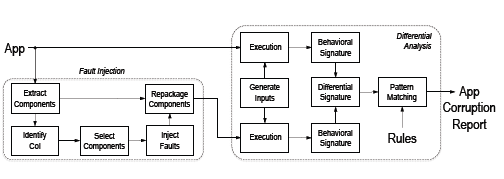
Malware for smart phones has rocketed over the last years. Market operators face the challenge of keeping their stores free from malicious apps, a task that has become increasingly complex as malware developers are progressively using advanced techniques to defeat malware detection tools. One such technique commonly observed in recent malware samples consists of hiding and obfuscating modules containing malicious functionality in places that static analysis tools overlook (e.g., within data objects). In this paper, we describe ALTERDROID, a dynamic analysis approach for detecting such hidden or obfuscated malware components distributed as parts of an app package. The key idea in ALTERDROID consists of analyzing the behavioral differences between the original app and a number of automatically generated versions of it, where a number of modifications (faults) have been carefully injected. Observable differences in terms of activities that appear or vanish in the modified app are recorded, and the resulting differential signature is analyzed through a pattern-matching process driven by rules that relate different types of hidden functionalities with patterns found in the signature. A thorough justification and a description of the proposed model are provided. The extensive experimental results obtained by testing ALTERDROID over relevant apps and malware samples support the quality and viability of our proposal.
AIM
The aim of this paper is ALTERDROID consists of analyzing the behavioral differences between the original app and a number of automatically generated versions of it, where a number of modifications (faults) have been carefully injected
SCOPE
The scope of this paper is Observable differences in terms of activities that appear or vanish in the modified app are recorded, and the resulting differential signature is analyzed through a pattern-matching process driven by rules that relate different types of hidden functionalities with patterns found in the signature
EXISTING SYSTEM
Smartphone malware has become a rather profitable business due to the existence of a large number of potential targets and the availability of reuse-oriented malware development methodologies that make exceedingly easy to produce new samples. Smartphone malware is becoming increasingly stealthy and recent specimens are relying on advanced code obfuscation techniques to evade detection by security analysts. More sophisticated obfuscation techniques, particularly in code, are starting to materialize (e.g., stegomalware ). These techniques and trends create an additional obstacle to malware analysts, who see their task further complicated and have to ultimately rely on carefully controlled dynamic analysis techniques to detect the presence of potentially dangerous pieces of code.
DISADVANTAGES
·      Recent malware samples consist of hiding and obfuscating modules containing malicious functionality in places that static analysis tools overlook.
PROPOSED SYSTEM
In this project, ALTERDROID, a tool for detecting, through reverse engineering, obfuscated functionality in components distributed as parts of an app package. Such components are often part of a malicious app and are hidden outside its main code components (e.g. within data objects), as code components may be subject to static analysis by market operators. The key idea in ALTERDROID consists of analyzing the behavioral differences between the original app and an altered version where a number of modifications (faults) have been carefully introduced. Such modifications are designed to have no observable effect on the app execution, provided that the altered component is actually what it should be (i.e., it does not hide any unwanted functionality). For example, replacing the value of some pixels in a picture or a few characters in a string encoding an error message should not affect the execution. However, if after doing so it is observed that a dynamic class loading action crashes or a network connection does not take place, it may well be that the picture was actually a piece of code or the string a network address or a URL.
ADVANTAGES
·      To support differential fault analysis over distinguishable components such as those involving Dex bytecode.
·      ALTERDROID is a powerful and novel dynamic analysis technique that can identify potentially malicious components hidden within an app package.
SYSTEM ARCHITECTURE


SYSTEM CONFIGURATION

HARDWARE REQUIREMENTS:-

·                 Processor               -   Pentium –III

·                Speed                -    1.1 Ghz
·                RAM                 -    256 MB(min)
·                Hard Disk         -   20 GB
·                Floppy Drive    -    1.44 MB
·                Key Board                 -    Standard Windows Keyboard
·                Mouse               -    Two or Three Button Mouse
·                Monitor             -    SVGA

SOFTWARE REQUIREMENTS:-

·                Operating System      : Android OS                                       
·                Front End                  : JAVA
·                Database                   : Sqlite
·                Tool                           :Eclipse


REFERENCES
Suarez-Tangil, G.,Tapiador, J.E. ; Lombardi, F. ; Di Pietro, R. “ALTERDROID: Differential Fault Analysis of Obfuscated Smartphone Malware”, IEEE Transactions on Mobile Computing Volume PP ,  Issue 99  June 2015