Showing posts with label coimbatore JAVA projects. Show all posts

Tuesday, 20 October 2015

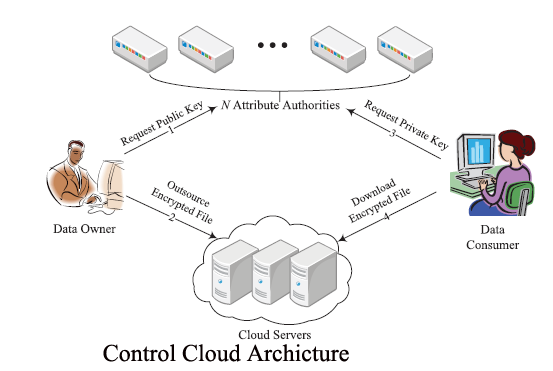
Control Cloud Data Access Privilege And Anonymity With Fully Anonymous Attribute-Based Encryption


ABSTRACT
Cloud computing is a revolutionary computing paradigm, which enables flexible, on-demand, and low-cost usage of computing resources, but the data is outsourced to some cloud servers, and various privacy concerns emerge from it. Various schemes based on the attribute-based encryption have been proposed to secure the cloud storage. However, most work focuses on the data contents privacy and the access control, while less attention is paid to the privilege control and the identity privacy. In this paper, we present a semianonymous privilege control scheme AnonyControl to address not only the data privacy, but also the user identity privacy in existing access control schemes. AnonyControl decentralizes the central authority to limit the identity leakage and thus achieves semi anonymity. Besides, it also generalizes the file access control to the privilege control, by which privileges of all operations on the cloud data can be managed in a fine-grained manner. Subsequently, we present the AnonyControl-F, which fully prevents the identity leakage and achieve the full anonymity. Our security analysis shows that both AnonyControl and AnonyControl-F are secure under the decisional bilinear Diffie–Hellman assumption, and our performance evaluation exhibits the feasibility of our schemes.
AIM
The aim of this paper is present a semi anonymous privilege control scheme Anony Control to address not only the data privacy, but also the user identity privacy in existing access control schemes.
SCOPE
The scope of this paper tend to Our security analysis shows that both AnonyControl and AnonyControl-F are secure under the decisional bilinear Diffie–Hellman assumption, and our performance evaluation exhibits the feasibility of our schemes.
EXISTING SYSTEM
First data confidentiality should be guaranteed. The data privacy is not only about the data contents. Since the most attractive part of the cloud computing is the computation outsourcing, it is far beyond enough to just conduct an access control. More likely, users want to control the privileges of data manipulation over other users or cloud servers. This is because when sensitive information or computation is outsourced to the cloud servers or another user, which is out of users’ control in most cases, privacy risks would rise dramatically because the servers might illegally inspect users’ data and access sensitive information, or other users might be able to infer sensitive information from the outsourced computation. Therefore, not only the access but also the operation should be controlled.
DISADVANTAGES

  1. The  data is outsourced to some cloud servers, and various privacy concerns emerge from it
  2. It most work focuses on the data contents privacy and the access control, while less attention is paid to the privilege control and the identity privacy.

PROPOSED SYSTEM
Various techniques have been proposed to protect the data contents privacy via access control. Identity-based encryption (IBE) was first introduced by Shamir , in which the sender of a message can specify an identity such that only a receiver with matching identity can decrypt it. Few years later, Fuzzy Identity-Based Encryption  is proposed, which is also known as Attribute-Based Encryption (ABE). In such encryption scheme, an identity is viewed as a set of descriptive attributes, and decryption is possible if a decrypter’s identity has some overlaps with the one specified in the ciphertext. Soon after, more general tree-based ABE schemes, Key-Policy Attribute-Based Encryption (KP-ABE) and Ciphertext-Policy Attribute- Based Encryption (CP-ABE)  are presented to express more general condition than simple ‘overlap’. They are counterparts to each other in the sense that the decision of encryption policy (who can or cannot decrypt the message) is made by different parties.
ADVANTAGES

  1.  It achieves not only fine-grained privilege control but also identity anonymity while conducting privilege control based on users’ identity information
  2.  The security and performance analysis which shows that Anony- Control both secure and efficient for cloud storage system.

SYSTEM ARCHITECTURE


SYSTEM CONFIGURATION

HARDWARE REQUIREMENTS:-

·                Processor          -   Pentium –III

·                Speed                -    1.1 Ghz
·                RAM                 -    256 MB(min)
·                Hard Disk         -   20 GB
·                Floppy Drive    -    1.44 MB
·                Key Board                 -    Standard Windows Keyboard
·                Mouse               -    Two or Three Button Mouse
·                Monitor             -    SVGA

SOFTWARE REQUIREMENTS:-

·                Operating System      : Windows  7                                     
·                Front End                  : JSP AND SERVLET
·                Database                  : MYSQL
·                Tool                           :NETBEANS


REFERENCE
Lei, Chin-Laung Chi, Po-Wen “CONTROL CLOUD DATA ACCESS PRIVILEGE AND ANONYMITY WITH FULLY ANONYMOUS ATTRIBUTE-BASED ENCRYPTION” IEEE Transactions on Information Forensics and Security, VOL 10,ISS 1, NOVEMBER 2014.


Drops: Division And Replication Of Data In Cloud For Optimal Performance And Security


ABSTRACT
Outsourcing data to a third-party administrative control, as is done in cloud computing, gives rise to security concerns. The data compromise may occur due to attacks by other users and nodes within the cloud. Therefore, high security measures are required to protect data within the cloud. However, the employed security strategy must also take into account the optimization of the data retrieval time. In this paper, we propose Division and Replication of Data in the Cloud for Optimal Performance and Security (DROPS) that collectively approaches the security and performance issues. In the DROPS methodology, we divide a file into fragments, and replicate the fragmented data over the cloud nodes. Each of the nodes stores only a single fragment of a particular data file that ensures that even in case of a successful attack, no meaningful information is revealed to the attacker. Moreover, the nodes storing the fragments are separated with certain distance by means of graph T-coloring to prohibit an attacker of guessing the locations of the fragments. We also compare the performance of the DROPS methodology with ten other schemes. The higher level of security with slight performance overhead was observed.
AIM
The aim of this paper is Division and Replication of Data in the Cloud for Optimal Performance and Security (DROPS) that collectively approaches the security and performance issues.
SCOPE
The scope of this paper is the DROPS methodology; we divide a file into fragments, and replicate the fragmented data over the cloud nodes. Each of the nodes stores only a single fragment of a particular data file that ensures that even in case of a successful attack, no meaningful information is revealed to the attacker.
EXISTING SYSTEM
The off-site data storage cloud utility requires users to move data in cloud’s virtualized and shared environment that may result in various security concerns. Pooling and elasticity of a cloud, allows the physical resources to be shared among many users. The data outsourced to a public cloud must be secured. Unauthorized data access by other users and processes (whether accidental or deliberate) must be prevented As discussed above, any weak entity can put the whole cloud at risk. In such a scenario, the security mechanism must substantially increase an attacker’s effort to retrieve a reasonable amount of data even after a successful intrusion in the cloud.
DISADVANTAGES

  1.  The data compromise may occur due to attacks by other users and nodes within the cloud.
  2.  The  employed security strategy must also take into account the optimization of the data retrieval time

 PROPOSED SYSTEM
In this paper, we collectively approach the issue of security and performance as a secure data replication problem. We present Division and Replication of Data in the Cloud for Optimal Performance and Security (DROPS) that judicially fragments user files into pieces and replicates them at strategic locations within the cloud. The division of a file into fragments is performed based on a given user criteria such that the individual fragments do not contain any meaningful information. Each of the cloud nodes (we use the term node to represent computing, storage, physical, and virtual machines) contains a distinct fragment to increase the data security.
 

ADVANTAGES
        The implications of TCP in cast over the DROPS methodology need to be studied that is relevant to distributed data storage and access

   To improve data retrieval time, the nodes are selected based on the centrality measures that ensure an improved access time.

SYSTEM ARCHITECTURE:-


SYSTEM CONFIGURATION

HARDWARE REQUIREMENTS:-

·                Processor          -   Pentium –III

·                Speed                -    1.1 Ghz
·                RAM                 -    256 MB(min)
·                Hard Disk         -   20 GB
·                Floppy Drive    -    1.44 MB
·                Key Board                 -    Standard Windows Keyboard
·                Mouse               -    Two or Three Button Mouse
·                Monitor             -    SVGA

SOFTWARE REQUIREMENTS:-

·                Operating System      : Windows  7                                     
·                Front End                  : JSP AND SERVLET
·                Database                  : MYSQL
·                Tool                           :NETBEANS
  
REFERENCE
Mazhar Ali, Kashif Bilal, Samee U. Khan “DROPS: DIVISION AND REPLICATION OF DATA IN CLOUD FOR OPTIMAL PERFORMANCE AND SECURITY,” IEEE TRANSACTIONS ON CLOUD COMPUTING VOL PP,ISS 99, February 2015.